
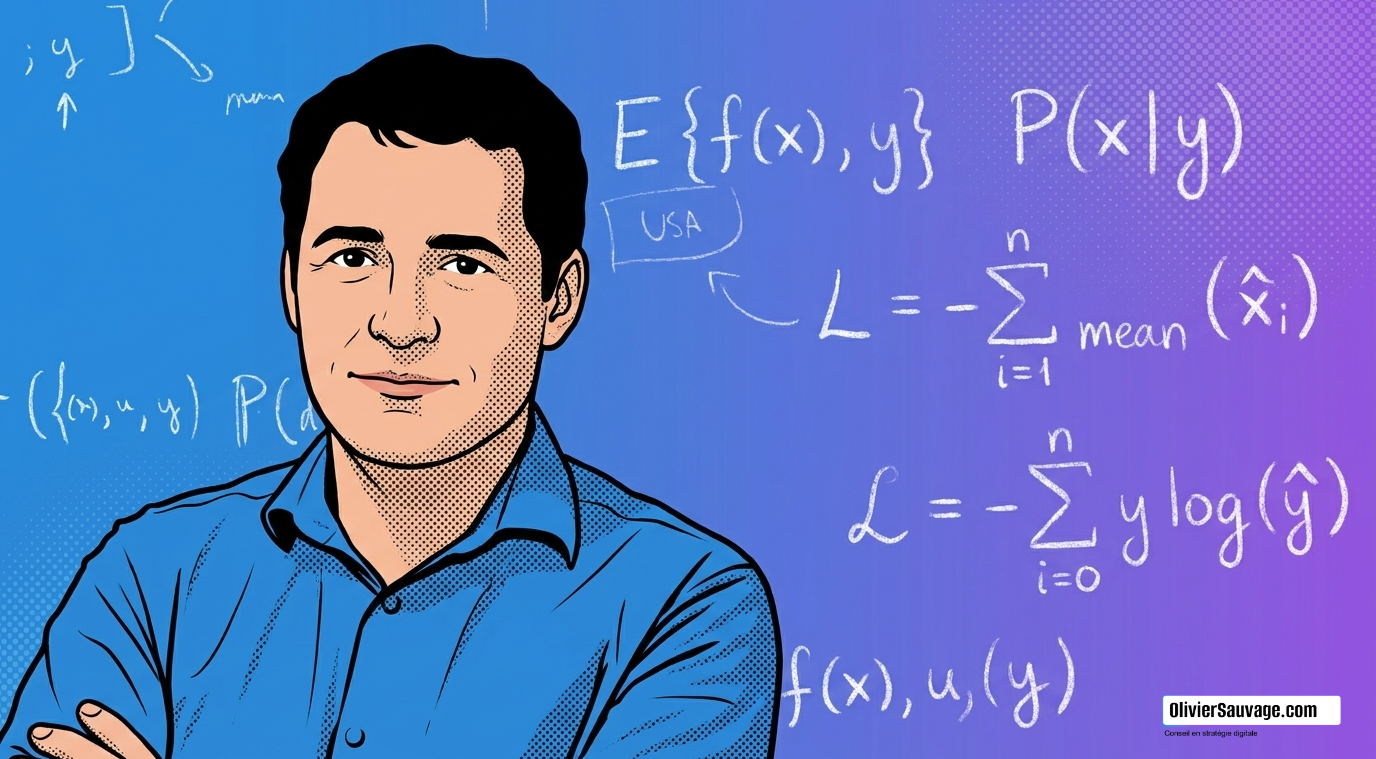

This article is an interview that addresses the topic of AI training for businesses with AI researcher, Manuel Davy, President of La Cité de l’IA.
Introduction
I had the chance and honor to have a discussion with Manuel Davy, AI researcher, founder of AIKO Group, and a great popularizer.

Manuel is currently one of the most influential AI players in the Northern French entrepreneurial landscape, and it would have been a real shame not to be able to gather his opinion on questions that concern all businesses today.
Together, we addressed the central question of AI training: what, why, who, how?
Happy reading!
Manuel Davy: an AI journey and a figure of the North
Olivier: Hello Manuel, before we start, can you introduce yourself and tell us about your background?
Manuel: My name is Manuel Davy. I am an engineer by training. I completed a doctorate in signal processing in the late 90s, a discipline already very data and machine learning oriented.
After that, I was recruited by Cambridge University as a researcher to work on a music project: extracting as much information as possible from a musical recording. This also led me, a few years later, to write a book on this subject: how to reconstruct a score from a recording. I then returned to the CNRS, where I spent about ten years as a researcher.
I arrived in Lille in 2003, at the same time as Inria’s establishment. There, I created a research team with other researchers on reinforcement learning and what is called sequential learning.
In 2008, I changed paths and became an entrepreneur. I created VEKIA, a SaaS supply chain optimization platform, which relies heavily on machine learning and operational research. I still lead it today.
I also joined La Cité de l’IA, a non-profit business network of which I am president. This network has about 150 member companies, representing nearly 2,000 people in our ecosystem.

In 2019, I took over the presidency of La Cité de l’IA, an initiative originally supported by the European Metropolis of Lille. And in 2024, we created AIKO. AIKO is a firm that supports companies in implementing AI across four areas:
- Strategic planning: providing a long-term vision of what needs to be done.
- AI system construction: we have engineers available on a fixed-price or time-and-materials basis.
- Change management: training, organizational adaptation.
- System operational maintenance.
Furthermore, as part of La Cité de l’IA, I host a podcast called Les Carnets de l’IA, which has a good audience in France on this subject.
AI training: a societal and professional challenge
Olivier: Today, we hear everywhere that we need to train in AI: training businesses, civil servants, middle school students… It feels like everyone has to get involved, almost as a hasty reaction to something moving very fast. But concretely, what does it mean to train in AI? Do people even know what they are asking for?
Manuel: Often, when people ask to be trained in AI, they simply want to be shown how to click on ChatGPT, create a prompt, etc. But that’s very insufficient compared to the scope of the subject.
AI is a technology that will profoundly transform our world, in work as in personal life, for better or for worse. Training in AI means first and foremost giving oneself the means to grasp the subject: what are we talking about? How is it used?
There are always these two aspects: understanding the technology and knowing how to use it. One of the challenges of training is precisely to answer these two questions. Otherwise, we have users who don’t really understand what AI does, nor why it generates one answer rather than another.
The difficulty is that AI touches everything: business, life, society. Therefore, dozens of subjects need to be addressed in depth. It’s not a topic that can be covered in 5 minutes around a table if we want to train enlightened citizens or employees.
Olivier: Precisely, what are the types of AI? When we talk about training, what exactly are we talking about?
Manuel: For 99% of people, AI is generative AI, because that’s what’s talked about in the media: generating text, music, videos, images… The big names are ChatGPT, Mistral, Claude, Anthropic, or even Chinese models like DeepSeek.
But AI is not limited to generative AI. It’s also a whole range of algorithms usable in different contexts: optimizing business processes, organizing delivery routes, etc. I often say that instead of talking about an AI race, we should talk about the AI Olympic Games: there are dozens of disciplines, like at the Olympics, each with its specializations and dedicated algorithms.
We tend to see AI as a monolith, when in reality, it’s a diverse field with many different things.
Olivier: Do all businesses need to train in AI? Does it concern both very small businesses and large corporations? And are there different levels of training depending on the profiles?
Manuel: As with all subjects, not everyone is destined to become an expert. But no one can truly afford not to understand AI and its impact, because, whether we like it or not, it has entered our lives and businesses. It’s also the first time a technology has arrived through employees rather than through management.
If you don’t deal with it, it will deal with you. Training means at least understanding the technology to be able to make informed choices, whether in our personal or professional lives.
After that, there are indeed more advanced levels depending on the activities:
- For students: learning to write, to gather knowledge with generative tools, but with all necessary precautions.
- For some in businesses: learning to code with AI, while remaining cautious about the results.
- For leaders: understanding the potential and risks of the technology to make it an asset for their employees and their company.
The risks of obsolescence and the urgency of training
Olivier: With the rapid evolution of technology, isn’t there a risk of training people on things that will become obsolete?
Manuel: This is where we return to the distinction between training for usage and training in principles.
- Usages evolve very quickly (tools, interfaces…).
- Principles, however, remain relatively stable: generative AI relies on machine learning, and this implies constants.
For example:
- An AI is more effective the more specialized it is: one must always seek specialization to achieve performance.
- It will always have an incompressible error rate: for critical things, one should never have blind trust.
- It requires data (even if generative models need less than others).
It is these principles that must be taught, as they will remain valid in the years to come, even as technological performance evolves.
Olivier: Why shouldn’t one train in AI? I’m thinking of a recent op-ed in Le Monde with a call from public figures arguing against the use of generative AI by the general public, for environmental, democratic, or societal reasons. Can a company still afford to ignore it?
Manuel: We always have the choice not to do it, but not training, not committing one’s company to the path of AI, is to begin its planned obsolescence.
I often draw a parallel with the 80s: in films from that era, like Working Girl or Die Hard, we see offices without computers. Just a phone and a notepad. Today, it’s hard to imagine how those people could be productive. Computing radically transformed work. AI is part of that same revolution.
Of course, excess is harmful. Businesses must learn to use it well, without unrealistic expectations or excessive fear. Generative AI in business is a bit like an intern: it allows things to be done, but it must be closely supervised, as it can still make many mistakes. However, for very structured and repetitive tasks, it works and can even be beneficial for the environment if use cases are chosen carefully.
The reception of AI in businesses: between enthusiasm and rejection
Olivier: How do people receive these trainings? Is there a fear of « the great replacement » or an optimistic adoption?
Manuel: When one fears what one doesn’t know, it’s highly correlated with the level of knowledge and training one has received.
In a company where I intervene, I would say there are:
- 20% of « excessive enthusiasts » who use it for everything, sometimes with blind trust.
- 20% of opponents who categorically reject it.
- 60% of reasonable users who test it from time to time, nothing more.
In the rejection of AI, two things are mixed:
- The rejection of the technology itself and its societal consequences (this is a legitimate debate).
- The rejection of the players pushing this technology (like Anthropic, OpenAI…), whose DNA is deeply capitalist. These companies are ready to do anything to establish themselves as leaders. I understand this rejection, and I partly share it. I do not share the rejection of the technology, but I share the caution one must have towards certain players.
My approach: I don’t want to infantilize people. I respect their distrust and answer their questions to dissect misunderstandings.
I also advocate for not forcing those who don’t want to use it to do so. The principle is that they retain the choice, but they are obliged to listen to what others are doing. For example, in a small 15-person structure, the executive assistant was resolutely against AI for fear of losing her job. A year and a half later, everyone was using it… except her. Not out of fear, but because she didn’t need it: she realized that AI brought her nothing in her daily life. That reassured her.
To explain this, I use a cognitive comparison: there are things humans can do that machines will never be able to do, at least with current technologies. This is a reassuring element.
Olivier: Is there a difference in appetite for AI depending on the hierarchy in companies?
Manuel: Not really. Even in factories, you see people tinkering with things on the corner PC during their break. It’s a question of mindset, of personal curiosity, not of generation or hierarchy. It’s also a question of time and technical means: some people don’t have a PC at home, they do limited tests on their phone.
Mindset is the primary factor.
Concrete benefits of AI training
Olivier: What are the real benefits for a company that trains its employees in AI?
Manuel: There are several levels of usage, and therefore several types of benefits.
1. Competent AI adoption
Training should not be a one-off event. It’s necessary to maintain skill development: meetings, practical exercises, peer exchanges. This is what I call competent adoption.
2. Type 1 uses (individual level)
- Main benefit: work quality.
- Sociological surveys like Yann Ferguson’s show that Type 1 AI does not necessarily generate additional revenue or profitability, but it improves job satisfaction and reduces stress, which has positive indirect effects on the company.
3. Type 2 uses (process level)
This is where tangible value begins to be generated:
- Transformation of how work is done within a team or between teams.
- Structuring an end-to-end process.
- Integration of AI in well-identified areas to gain efficiency.
To move to Type 2, one must have gone through Type 1 (for its training and pedagogical aspects).
Olivier: Concretely, how does a learning cycle work?
Manuel: We start with a general presentation of the technology:
- What is artificial intelligence?
- How to recognize it?
- How does it resemble and differ from humans or classical computing?
Then, there is a practical part:
- For those who have never practiced, we show them how to connect to a generative tool (Mistral, ChatGPT, Claude…), how to interact with it.
- The objective: to take a concrete problem faced by employees (e.g., « I have to write a lot of emails, how can AI help me? ») and help them build their own personal process to be more efficient.
To summarize, in the adoption of AI in business, I remember the PPDA rule (nothing to do with the journalist!):
- People (les gens)
- Process (les processus)
- Data (les données)
- Algorithm/Agent (les outils)
One must start with people, then look at processes. Data and algorithms come after.
Olivier: Do you also train developers?
Manuel: Yes, at La Cité de l’IA, we have created a developers’ club that will start in September. There will be six meetings during the year:
- Expert interventions to show how they develop with AI.
- A discussion and peer-exchange space for collective skill development.
Developers: as everywhere, there are:
- 20% who go all in.
- 20% who are terrified (fear of disappearing).
- 60% who tinker a bit.
The challenge: to structure uses and define new professional practices (code quality, maintainability, security…).
Generative AI tools: which one to choose?
Olivier: Are there generative AI tools or models that are better than others?
Manuel: It depends on the use cases.
- For code: Claude is ahead, even if ChatGPT and CodeChat GPT are also very good.
- For integration: the Chinese are taking the lead (cheaper, integrated ecosystem).
- Gemini (Google) is interesting if you are already a Google customer.
- Copilot (Microsoft) is good if you use Azure 365.
What matters more and more is cost. Features (like work organization, background tasks) also make a difference, but these are not very complex things. All players will align, and a few will take tangents to innovate.
Training young people and the impact on the brain
Olivier: Should young people be trained in AI in middle school or high school?
Manuel: Absolutely. It’s a subject that has entered our lives. Not being able to talk about it is catastrophic. An enlightened citizen is a citizen who understands their environment.
For those entering the job market, not knowing how to use generative AI is like a doctor not knowing how to use a stethoscope. For example, a developer must know how to code without AI and with AI. If you don’t know how to code without AI, you won’t know how to code with it.
It’s a real challenge for teachers: adapting training very quickly.
Olivier: Does AI make us stupid by relieving us of intellectual tasks?
Manuel: AI makes us dumb like cars make us fat. If we stop making an effort, the muscle atrophies, and it’s the same for the brain. It’s a real risk.
Socrates was against writing because he thought it would make people lose their memory. We must remain cautious.
What is certain is that AI will shift our brain’s potential towards less basic tasks. Today, we spend a lot of time on execution tasks, when we could be focusing on other forms of thought.
It’s a reconfiguration of our brain for which we are not ready, because our education does not prepare us for it. One more reason to train young people in AI: to prepare them to live in a world where we will do much less than in our time.
But be careful: we cannot absolve ourselves of the essential knowledge of our profession. We remain the judge of the result. We must know how to verify what AI does, and for that, we need to acquire the necessary skills.
The government’s AI plan and advice for an SME
Olivier: What do you think of the government’s AI plan (launched in 2025) and the creation of an AI academy?
Manuel: The fear of public authorities is that France will fall behind by not adopting the technologies that will be part of tomorrow’s competitiveness factors.
I am not very critical of this project. What has been done with IA Booster and BPI (which now integrates the Osez l’ia program) has worked quite well and has helped many companies.
On the other hand, I am not in favor of investing hundreds of billions in data centers. Building centers with billions of euros worth of Nvidia chips that will be obsolete in 3 years is not a good strategy. We need compute, yes, but reasonably. We need to build a few data centers for research, but not hundreds like some countries are doing (like South Korea, which wants to invest the equivalent of a third of its GDP in data centers).
Olivier: If I’m an SME owner and I know nothing about it, where do I start?
Manuel: Go to La Cité de l’IA! More seriously, there are several avenues:
- BPI France is a good aggregator. Call your BPI advisor, they will be able to direct you to experts.
- There are online courses or courses specifically designed for business leaders.
Conclusion: an endless but necessary battle
Olivier: Thank you very much for this intense and fascinating discussion.
Manuel: My pleasure! Olivier: Looking forward to seeing you in person one of these days!
Manuel: With great pleasure. Have a good day!

AI expert (PhD, HDR), Manuel Davy is CEO of Vekia, co-founder of Aiko, and President of La Cité de l’IA. With 17 years of experience, he has developed AI solutions to optimize inventory, reduce costs by 15%, and improve cash flow by 30%.
Passionate about innovation, he is committed to democratizing AI, supporting companies towards ethical and efficient deployment.
Laisser un commentaire