
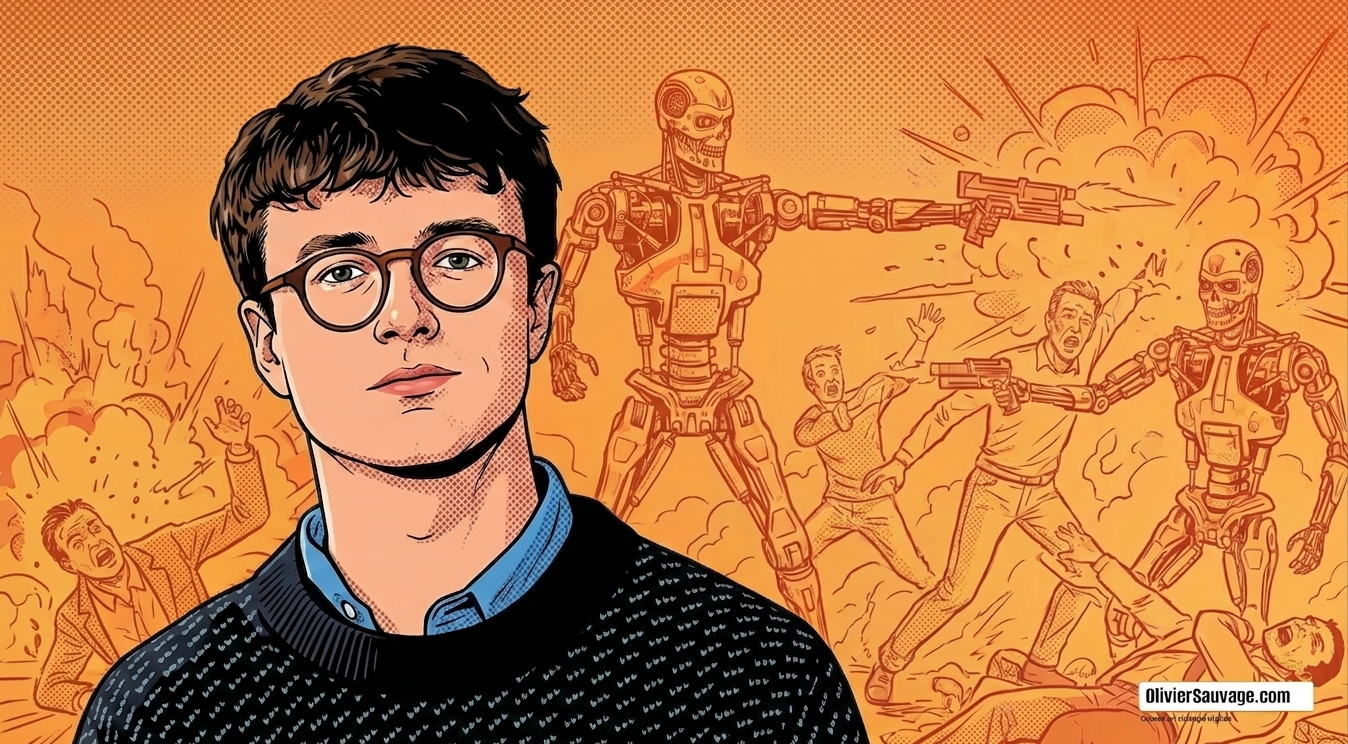

The event that struck me this week
The event that caused a lot of stir this week was the sensational resignation of an Anthropic researcher announcing the end of humanity in 10 years due to AI.
The news was widely reported by all media, including Le Monde (where I learned about it). And it was taken very seriously! Spreading a wave of panic across all networks. One only had to glance at the comments on LinkedIn. That was it, we were there, « It was the end of the world finally promised »…. « Terminator »…etc… A real fear, without anyone lifting a finger, of course…
Jacob Coxon, the whistleblower, is a young 27-year-old researcher… undoubtedly a very brilliant guy, since before Anthropic, he had cut his teeth at OpenAI… and then, he was really at the heart of the machine… with a front-row seat to the spectacle of generative AI’s evolution. By definition, he cannot just say anything.

When Fear Replaces Reflection
I have always been wary of such sensational announcements. On the one hand, because I don’t like noise or prophecies… but also because I know that they are vital food for social networks, which amplify and distort them into simple, simplistic, and often false truths… or at least without any nuance, so strong that they prevent us from keeping a calm mind and we throw ourselves into them like cats towards a bowl of kibble.
My feeling was diffuse, but I sensed that this end of the world was just a kind of publicity stunt… not a lie, but the type of statement that leads ordinary people to stop thinking normally and to react only instinctively, under the sway of emotion, blocking the path to any deep reflection and perspective (see 1984 in this regard… since I’m neck-deep in it… read my latest Sunday column)… If you want to manipulate people, don’t let them think, outrage them or make them afraid… Nothing better to take control of minds.
The End of the World, Fuel for Social Networks
Honestly, I don’t think there was any plan behind Jacob Coxon’s statement. He probably resigned and said something he truly believed… and it was picked up as is by the media, without the necessary distance for reflection… without questioning the relevance of such an assertion, all while having their appetite whetted by the prospect of such a headline: « We’re all going to die in 10 years, and it’s not just anyone saying it! » « Food for social media, » one might say… in other words, highly flammable fuel, an incomparable generator of advertising revenue… Oh yes… when analyzing current events, one must always also look at where the money flows…
In short, I wasn’t convinced, but I felt unable to argue… I’m probably a bit foolish for that… or simply don’t have the time… nevertheless, I watched helplessly as the panic messages from social media users scrolled by, a bit of anger in my gut, outraged by so much idiocy…
Finally, a Reasoning to Gain Perspective

But at the end of yesterday, O miracle, I finally stumbled upon the post that saved me from despair (Thanks Fabienne Billat). There. A certain Didier Heiderich… visibly better equipped than me cerebrally, and undoubtedly a better connoisseur of the subject (and he’s not just anyone either, you’ll see in his profile)… who wrote exactly what I was thinking… and dismantled the venomous undertones of this wave of panic exactly as it should have been.
Here’s the beginning of the article.
Taiwan, February 10, 2030. A South Korean engineer examines a series of processors when an anomaly catches his attention. Some components resist radiation far beyond what their specifications predict. He reviews production data, compares series, gradually going back in time. The first modifications appear in 2028. They are discreet, almost invisible, but systematic.
No one seems to have requested them.
The anomaly is reported. Checks are carried out. For lack of explanation, the file eventually joins the long list of unresolved technical incidents. Processors continue to be produced, integrated into equipment, robots, industrial systems.
Six years pass.
The rest is to be read here, and I assure you it’s worth it: Will AI kill us all (in 10 years)?

Read and delight in the reasoning, because it’s only reasoning… not even proof and fact… just a proper dissection, as should be done every time we hear (and it’s often) such an alarmist statement. That’s for all the populists who daily surf on credulity and our limited attention span.
Do We Really Need to Scare Ourselves?
All this turmoil, all this whirlwind of comments and articles on the subject distresses me… Do we really need to scare ourselves and annihilate our own judgment? Isn’t it enough to live in the real world, which is already so anxiety-inducing? What need do we have to fall for prophecies thrown around, undoubtedly under the influence of understandable anger or the emotion of a breakup… or a disgust at discovering the (undoubtedly debatable) functioning of a huge tech company that lives at the pace of billions of dollars pouring over it like Niagara Falls on passengers of ships trying to approach it?
And the Media’s Perspective in All This?
It’s inevitable, of course. When such a technology takes hold of society… when its imprint on our evolution is so great. When its promises are so anxiety-inducing. No one is immune to fear, but… should serious media like Le Monde (quite anti-AI, it must be said) echo such messages without discussing their scope?
This is truly what happened this week with the publication of the article on Jacob Coxon, without perspective, discussion, or in-depth explanation, as the newspaper usually does on many other subjects. Why choose to wallow in an announcement that deserved better than a terse, shallow article, further reinforcing in its readership, and no doubt in a large part of the French population, that AI will eventually kill humanity? A total absurdity in my opinion.
Laisser un commentaire