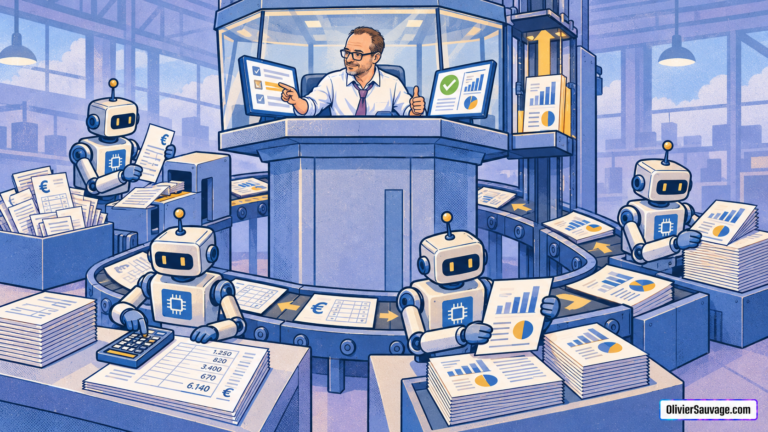

Only time will tell if Gemini 3 has truly ushered us into a new era. If we can look past the hype and the usual social media frenzy, something might actually be happening: a shift toward liberation, a possible seizing of power by humans over AI, or at least a multiplication of human capabilities thanks to AI. That is what has struck me since yesterday: the sheer number of demonstrations by those who immediately seized upon it—programs, videos, images, document creation—and their ability to exponentially increase their capabilities of all kinds, as if they had been handed a supercomputer capable of executing most tasks usually asked of a machine.
I increasingly get the feeling that the world of (intellectual) work will be divided into two populations: those who master these tools, and those who become enslaved by them, merely acting as consumers. And therein lies the danger looming over the working world: a class of “knowers”—intellectually well-trained, cultivated, capable of juggling AI like a super-brain full of super-powers, monopolizing all corporate functions—versus a class that uses AI the way one uses a candy or peanut vending machine, only good for entering prompts, thinking they dominate the machine while actually abdicating all critical capacity, knowledge, and reasoning power.
The famous MIT study that briefly flashed across social media—alarming all the AI pundits who saw in it yet another monstrosity produced by American ultra-capitalism designed to lobotomize us all—merely demonstrated a truth that was already well known: delegating tasks to an AI does not teach you how to perform that task and causes you to lose the know-how to execute it, just as GPS caused us to lose our sense of direction.
For those who lack the “weapons” to use AI, this is precisely where the danger lies: the sensation of mastery, the sensation of knowing, the sensation of power. Yet all these sensations can only be illusions if one lacks precisely the knowledge, culture, and education that allow one to judge the results produced by AI. The novice who thinks they are a lawyer because they managed to extract a legal point thanks to an AI would be completely mistaken. When teenagers confide their distress to an AI as if it were a shrink or a friend, the confusion is total and reveals the extent to which the least trained, least mature, or most vulnerable beings can become the unwitting playthings of a technology that can lead them, in the worst cases, to death (see the teenage suicide cases).
The “augmented human” is not a pipe dream: the best-prepared will fully benefit from the possibilities of AI and tools like Gemini 3—multimodal tools capable of generating video, images, writing text, summarizing, coding. It is undoubtedly the most extraordinary thing humanity has invented in less than 20 years!