I know, I know, the question is a little provocative… but I mean it quite seriously.
For more than 25 years, businesses have been trying to attract website traffic and turn visitors into customers.
It seemed natural… More visitors meant more conversions: leads, sales, subscriptions or people signing up for a service.
Sometimes, you could even buy traffic and generate sales. It was a very simple model… and it worked well for a long time. But gradually, marketers noticed that things were changing. Especially with the arrival of ChatGPT and Google’s much-discussed AI Overviews, those AI-generated answers that appear at the top of some search results pages.
Attracting traffic is becoming more complicated on some channels. A Pew Research Center study, which examined the browsing activity of 900 US adults in March 2025, found fewer clicks on Google’s traditional search results when an AI-generated summary was present.
To my mind, this goes beyond a passing trend… It is a fundamental shift in how B2B businesses need to communicate.
What “zero click” changes for marketers
This weekend, I read Zero Click Marketing, by Amanda Natividad and Rand Fishkin, both at SparkToro, a US audience research software company… and they know a thing or two about the subject.
I learnt some very interesting things. Here is what I took away, along with a few thoughts of my own.
1. Less traffic does not necessarily mean fewer customers
Falling traffic is a reality for many websites. But, as I explained in an earlier article (in French), that is not necessarily bad news.
You can have less traffic but better-qualified visitors who have already done some of their research elsewhere. That does not happen automatically, of course… but the number of visits alone cannot tell you whether business is going well or badly.
2. Buying intent develops before the visit
Many marketing teams measure the performance of their acquisition channels through the visits and conversions they can attribute to them. They risk setting the wrong objectives because they do not fully understand how buying intentions develop.
This is what I have always thought… Many teams measure what happens when people arrive on their website, but pay much less attention to everything that happens beforehand. That gives an incomplete picture of how people are prepared for and influenced towards a purchase.
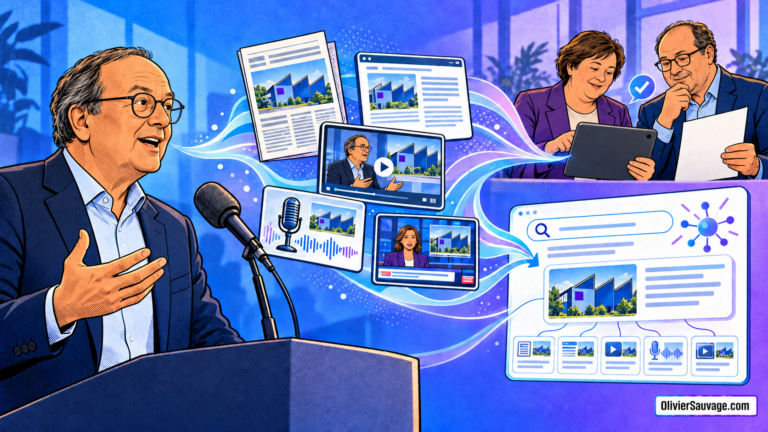
Amanda Natividad clearly explains the limits of attribution in an article on zero-click marketing. A prospect might discover your business through a podcast, read several of your posts, discuss it with a colleague… then type your name straight into Google.
Measure only that final step and you miss a large part of the story.
3. Organic website traffic is getting harder to earn
Organic traffic, which does not come directly from paid advertising, is becoming harder to attract on some channels.
Google answers more questions directly on its results pages. Social networks try to keep users on their own platforms. As a result, publishing an outbound link guarantees neither visibility nor visits to your website.
That is the principle behind the “zero-click” content described by SparkToro: offer something useful where people already are, without always asking them to click to access the information.
4. AI tools can influence choices before anyone visits
AI-powered search engines and assistants can play a part in how people discover a business, compare solutions and form an opinion.
Their accuracy sometimes leaves something to be desired… but that does not stop their answers from influencing decisions. How large a role they will play remains to be seen, without assuming that they will replace every other channel.
5. An email address has to be earned
I would add another difficulty: persuading someone to share their email address.
With repeated approaches, misuse of email addresses and newsletters of little interest, it is easy to understand why people hesitate. You need to give them a good reason to subscribe… and then keep your promise.
Is marketing going back to the days of radio and newspapers?
But marketers are not completely screwed… 🙂
What Amanda and Rand explain reminds me of marketing before the internet: radio, television, advertising and print newspapers.
Back then, audiences could already be measured, particularly through panels and surveys. Linking each purchase precisely to an advertisement was another matter… Yet that did not stop businesses selling or communicating.
The techniques were sometimes blunt and intrusive: adverts in the street, on the Underground, on the radio, on television… But, for better or worse, they influenced people’s opinions. And they still do.
In digital marketing, we will need to rediscover some of that thinking: looking at views, visibility, mentions and brand recall… not just clicks.
There is one caveat, though: accumulating views is not enough. We also need to see whether visibility among the right people is accompanied by sales enquiries and purchases.
The website still matters. How people reach it is changing
This does not mean giving up on bringing people to your website, or doing without one altogether. Rand Fishkin explains why websites still matter in the zero-click era: they remain a place where a business controls its content, presents its offering and enables people to take action.
But the way visitors arrive is changing. B2B businesses may no longer be able to rely solely on SEO or paid traffic.
They will need to distribute their efforts more effectively across the channels their customers use, without expecting a click from every view. For an SME, that might mean choosing a few relevant channels and working on them consistently, within a manageable budget.
This will change both the messages and the communication strategy: influence that is more dispersed and harder to attribute precisely, but can still deliver results.
Want to discuss this or learn more? Find me on oliviersauvage.com or follow me on social media. I keep an eye on these questions for you, always trying to avoid getting swept up in trends and fads.