

Forget Traditional SEO: Welcome to the GEO Era
If you’ve been following my thoughts lately, you know I’ve been thinking a lot about the future of online visibility. For years, the rules of the game were simple: please Google. We optimized our tags, chased backlinks (the famous backlink), and crossed our fingers to climb into the 10 blue links on the first page. But today, the rules have changed. Generative artificial intelligences (LLMs like ChatGPT, Claude, or Gemini) are disrupting our search habits. We no longer look for a list of links; we look for an immediate answer.
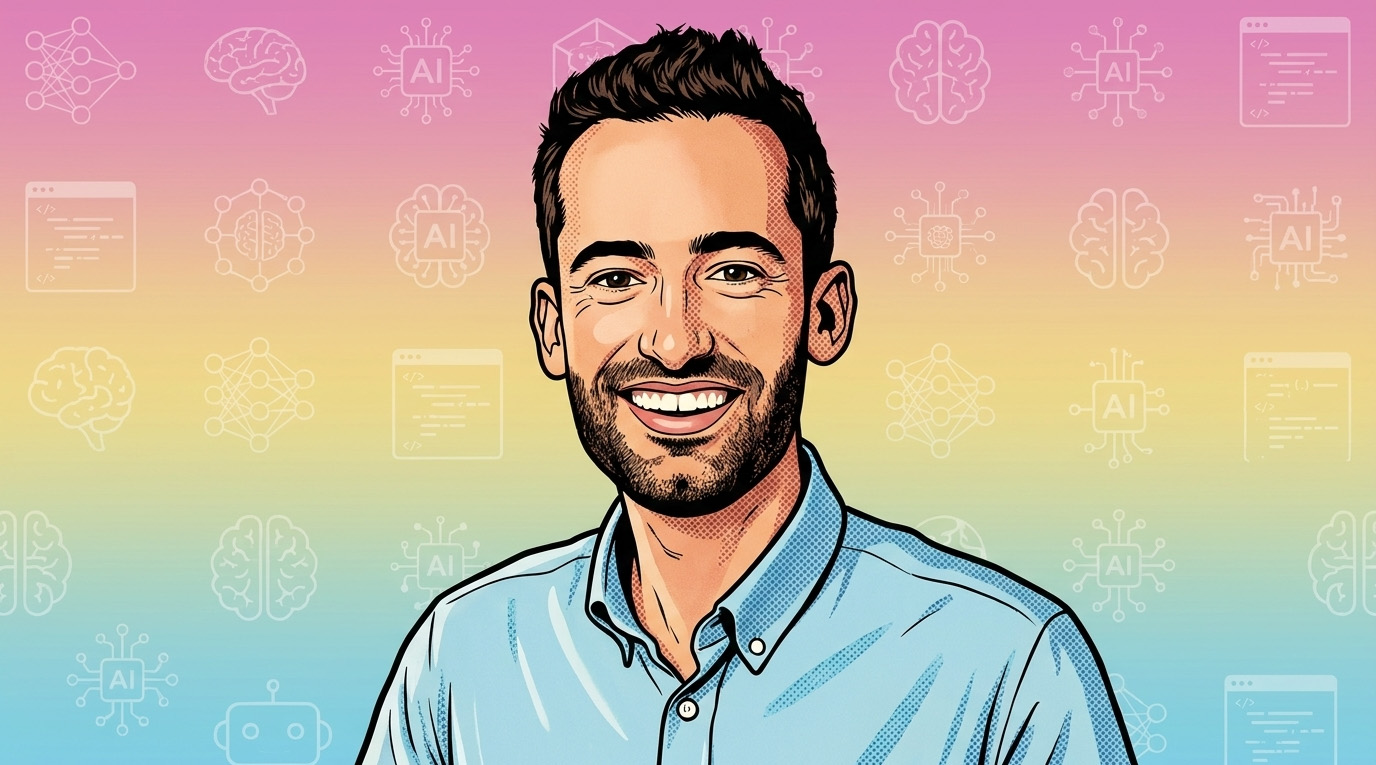
This new paradigm has a name: GEO (Generative Engine Optimization). To concretely understand where we stand and how businesses should react, I had the pleasure of interviewing Luca Fancello, co-founder of Qwairy, one of the most promising GEO analysis tools on the market. Let’s dive into a detailed report that might just change your approach to digital marketing.
From Links to Mentions: The Metric Shift
To begin, I asked Luca to explain concretely what optimizing for generative AIs means compared to classic SEO. For someone who knows nothing about it, what’s the big difference? His answer was crystal clear: it’s about moving from a logic of links to a logic of mentions.
« We try to look for a link, a backlink as we say, a return link [on Google]. Today, we’re going to try to look for a mention in an article. Because we know that the more AIs see you mentioned, the more they will highlight you. »
— Luca Fancello
Clearly, where Google’s robot navigated from hyperlink to hyperlink to understand a page’s popularity, LLMs read the web and identify the entities that are talked about the most. Of course, this immediately raises a question: if yesterday we bought links on specialized platforms, can we buy mentions today?
Luca confirms that the practice already exists. The French-speaking market, very fond of buying links via platforms like Rocket Links or others, is adapting. These same platforms are evolving to offer the purchase of mentions from one site to another. And in the face of this, LLMs (just like Google, for that matter) have a lot of difficulty detecting whether it’s a purchased or organic mention, provided it’s done naturally.
The Advent of « Reputational SEO »
But be careful, don’t think that simply flooding the web with mentions, whether purchased or not, is enough to become ChatGPT’s darling. This is where Luca raised the most crucial point of our discussion: reputation has become the absolute filter. I had a real « aha! » moment when he illustrated his point with a very simple example.
« Let’s say now you ask ChatGPT ‘what’s the best ceiling fan’. It will base its answer on many sites that have articles about ceiling fans, but behind that, it will also do something else: it will base it on your ratings on Trustpilot, on those kinds of sites. So if you’re mentioned everywhere on the web, but your Trustpilot rating is actually 1/5, it will probably say ‘beware of that thing’. »
— Luca Fancello
The LLM no longer just searches a few sites. It synthesizes information and, in a way, creates an overall credibility score for your brand. Luca has named this concept Reputational SEO.
For a long time, traditional SEO consisted of positioning oneself at all costs in an isolated environment. Your Trustpilot rating had very little direct impact on your Google ranking. Today, it’s the opposite. It’s the building of a strong brand, a solid and honest reputation across the entire web that will fuel your visibility. You can’t cheat with user reviews in the same way you buy mentions.
Breaking Down Silos: The Consultant’s New Role
This shift towards reputational SEO imposes a profound structural change within companies. The era when the SEO team worked alone in its corner is over.
« Before, traditional SEO was very siloed. You had an SEO team that handled one thing. Now, SEO teams need to be much more multichannel […] Typically, if you want to increase your Trustpilot ratings, you’ll have to collaborate with maybe ‘sales’, maybe other teams to really boost that. »
— Luca Fancello
Even on social media or third-party platforms like Amazon, negative comments directly impact the LLM’s final response. Luca also cites the example of a market in Germany where a product was poorly rated on Amazon: the LLM recommended it much less than in other countries, despite it being a huge market for the brand.
This is why Luca believes the term « SEO Consultant » is becoming obsolete. Today, a good professional is an organic consultant. Their role is to visualize all web data, audit Google Maps, Amazon, review platforms, and advise the company on a global influence strategy.
Massive Golden Traffic: Multiplied Conversions
Why bother investing in this new form of optimization? Because the return on investment is potentially enormous. Although it’s still complex to precisely measure the market share between Google and LLMs, tracking tools (via declarative surveys or other methods) give us extremely powerful signals regarding traffic quality.
💡 x3 to x4: The conversion rate is sometimes 3 to 4 times higher when customers come from ChatGPT or another LLM.
The reason is simple: the LLM user is engaged in a conversational process. When they arrive on your site or at your distributor after a long conversation with an AI that has dissected their needs and recommended your product, they are already qualified, convinced, and ready to convert.
The Reddit Case Study: Beware of Mirages
During our discussion, I wanted to address the topic of Reddit. In the United States, it’s a craze. Generative AIs seemed to feed almost exclusively on Reddit forums, and I had the impression that the trend was arriving in France. Luca dropped a bombshell by revealing data from a recent study conducted by Qwairy.
« Last week, there was a new ChatGPT model, and we did a study. We saw that Reddit mentions went from something like 60% to 2%. It significantly reduced Reddit mentions as a source. »
— Luca Fancello
Even before this update, if ChatGPT cited Reddit a lot, it ultimately represented only 2 to 4% of all globally mentioned sites. For Luca, rushing towards Reddit is a tactical error. Just because ChatGPT cites a source doesn’t mean you should dive in headfirst, without ensuring it integrates into a global strategy aligned with your budget.
Especially since Reddit has its own codes. It’s a fantastic monitoring tool for understanding the questions your industry is asking. But doing marketing or influence there is another kettle of fish. Moderators are unyielding with commercial aggressiveness. Luca reminds us of Reddit’s golden rule: « Out of 10 interventions, only one should potentially concern your brand. The other 9 shouldn’t even concern your brand. » You must first foster disinterested conversations to build your « karma » and gain legitimacy.
Qwairy: From Observation to Action
Of course, I wanted to know more about the tool Luca co-created. Venturing into LLM analysis today, at the dawn of this shifting technology where answers vary from one question to another depending on personas, is a bold gamble. What ignited the spark?
Qwairy’s ambition is clear: not to be just another monitoring tool, but to become a true decision-making tool. In a tight economic situation where companies are looking for profitability, actionable insights are needed.
« We’ll have a ‘content opportunities’ section. We’ll say: here’s the content you should create to be more visible on AIs. ‘Backlink opportunity’, we’ll say here are the mentions to get on which site, and even here’s the price because we’re connected to different marketplaces for potential purchase. »
— Luca Fancello
Qwairy was born to respond to strong market signals. Today, although there are already about forty players in this new segment, Qwairy’s specificity lies in its « Action Center ». The tool tells you if your current articles are optimized to be cited by AI, or guides you on the actions to take. The icing on the cake for our data: it’s a French product, hosted in Europe, and the team is currently preparing for ISO 27001 certification. In two years, the goal is to compete with global leaders while expanding further internationally.
« Zero-Click Marketing »: The Nissan Example
To illustrate the power of the phenomenon, Luca told me about one of his clients: Nissan. For this automotive giant, the number one priority was to master AI discourse, understand what ChatGPT was saying about their models, and identify users’ true searches.
Luca’s anecdote is striking: he recently spoke with someone who entirely chose their new car by conversing with ChatGPT. Once the decision was made, this person went directly to the dealership to buy the vehicle. On Nissan’s side, no one ever saw this user on the official website. This is the very essence of Zero-click marketing. The purchase journey took place entirely outside the brand’s controlled ecosystem.
SMEs Are Not Left Out
One might think that these issues are reserved for large accounts or international e-commerce. I shared with Luca my recent experience with the manager of a local company (a very small business of about ten people). This business owner has no commercial strategy, no SEO, and their market is tightening. And yet, when they wanted to analyze the reputation of their company and its competitors, what was their first reflex? They used ChatGPT!
For Luca, it’s telling: « It’s all the more comical because he would never have done that on Google for years. » The conversational interface democratizes access to strategic information, even for traditional or industrial SMEs. This is also what motivated me, as a consultant, to offer GEO pre-audits with Qwairy to my prospects (combining this with SEO audits and social media). Showing a local or B2B company how AI perceives its weaknesses is today the best way to raise awareness.
Conclusion
The message is clear. To be visible tomorrow, you will need to master your « reputational SEO ». This means either creating content so relevant that AI will source directly from you (allowing you to control the narrative), or working on your omnipresent and authentic presence across all relevant sites in your sector.
A big thank you to Luca Fancello for this fascinating discussion. The world of Search is undergoing a profound transformation, and we will need to equip ourselves, experiment, and, above all, stop thinking in silos. And if you want to know what AIs really think about your company, don’t hesitate to contact me. We can look into it together.

Luca Fancello is the co-founder of Qwairy: a SaaS platform for GEO (visibility on AIs like ChatGPT).
He is also an SEO/GEO expert: consultant, author, and trainer for over ten years.
Co-host of Position 0: a reference podcast for natural referencing.