
When I hear the phrase « But I don’t know how to write a prompt, » I perk up my ears and turn my head slightly.
The Prompt Block
You wouldn’t believe it, but many people are uncomfortable with AI tools.
The problem is that they are now everywhere, and those who sink into this fear risk losing even more ground.

It’s inevitable.
That’s not all.
The Illusion of the Basic Q&A
And I meet many more for whom AI is just a chat. They ask a question, and the AI answers. They’re stuck in 2022.
They are not D-students. They are sometimes highly educated people, executives who pay – or get paid for – a ChatGPT subscription, but who still use it as a simple Q&A tool.
When I talk to them about agents, they only have a vague idea of what it is, even though they are aware that it’s something important.
Everywhere, but Sometimes Very Disappointing
AI is everywhere now. I use the Google suite, but I suppose it’s the same for Microsoft; it oozes from every corner of every app, and every user is constantly urged to use the tremendous benefits it brings.
And one can certainly feel foolish not knowing what to do with it… or wasting time trying to use it well. AI can be as exciting as well as off-putting. In Google tools, its clumsiness is sometimes pathetic. Elementary things escape its capabilities, even though its « brain » is packed with more information than all human beings on Earth combined. You can give up on it quickly when two or three attempts lead to failure. This happens often.
Many Tools, Few Actual Uses
I think we could make the general observation that everyone in a company has access to AI, but no one truly profits from it… AI has something magical that dazzles us, but as soon as it’s time to get down to business, it tends to elude us.
It makes us waste too much time presenting strange and quirky results.

We quickly realise that we can’t implement it with other business tools, and we often end up copy-pasting there and there.
We certainly have something extraordinary in our hands, but it seems difficult to exploit. AI brings so many changes to the way things are done that it goes against the conservative nature of most human beings.
Natural Resistance to Change
Don’t tell me otherwise.
Most of us hate change.
Having to make an effort to do something differently is bothering.
It’s not a matter of lack of curiosity or enthusiasm, but simply a problem of saving brain energy. Change requires effort.
The Experience of the Independent and Augmented Worker
As an independent worker, I am fortunate to be able to discover and experiment with new techniques every day. Today, I work almost 90% of my time with AI. For a great many things: developing my own tools when they don’t exist, summarising texts, transcribing videos, creating images, thinking about problems.
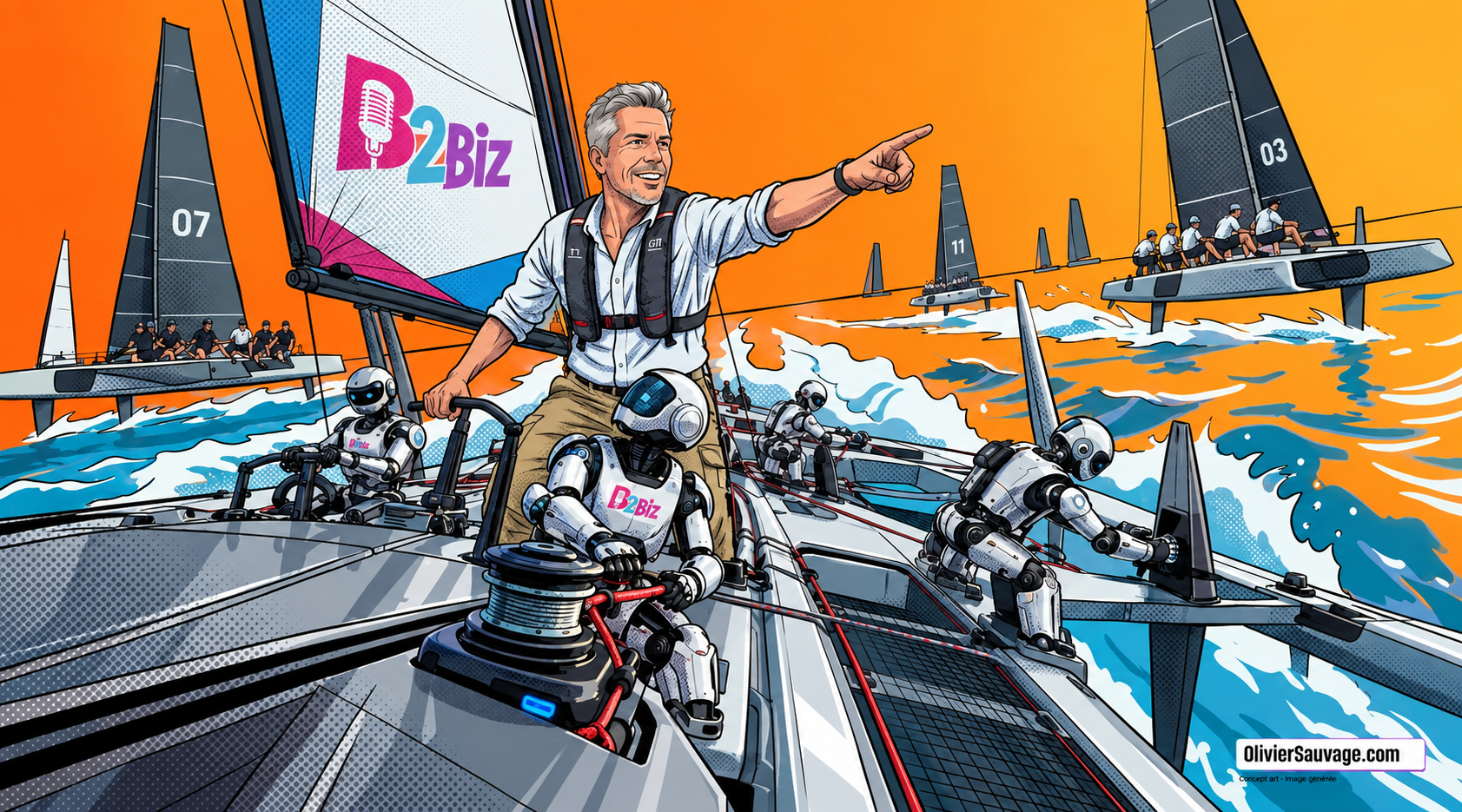
Day after day, I feel more and more augmented by AI… without forsaking my intelligence, as I increasingly resemble a captain with a crew of cute little agents doing a bunch of tasks for me. I have rediscovered immense pleasure in working, because everyday, I can almost get rid of all tedious tasks, or because everyday, I can do things I did not know how to do.
The Freedom to Experiment
This is possible for me because I have no hierarchical or budgetary constraints, and no one will blame me for wasting my time developing a tool to quickly extract data from my CRM database when a feature doesn’t exist or has a price, and I don’t want to pay a pricier subscription.
That’s how it is. And it’s true that it’s hard to imagine employees in a company having so much freedom.
Why Does the Company Lag Behind?
When I think of all I do in a day, and what I couldn’t do before?
When I see how fast I can progress, I keep telling myself that for many companies, the use of AI isn’t keeping up.
No one wants to take the risk of generalising it.
Obstacles and Risks Perceived by Management
There’s the issue of data confidentiality.
That of trust in employees (« If they start developing things, when will they do their actual work? »).
That of measuring effectiveness: do we actually save time with AI? Do we really do better? Are we more or less tired at the end of the day (very serious question)?
We know today that, on average, employees manage to be more productive with AI at their level, but this doesn’t translate into company figures. Contradictory. Yet, a priori, a company where all employees are AI-ready should be much faster, agile, powerful… that doesn’t really seem to be the case nowadays, at least not in most companies.
The Productivity Paradox
No doubt for the reasons I mentioned above. Because there’s a reluctance to integrate these famous tools. A fear of loss of control on the part of managers… the fear of risk. That’s where the brake is. I don’t believe in employee reluctance, but rather in management’s fear. The transformation is so powerful that it paralyses them. Training exists, but I feel like it often remains a dead letter. We get trained and then forget (as with many training courses… if you ask me).
A Sclerotic and Corseted Business Model
It’s not a symptom of a lack of curiosity or skills… it’s a symptom of companies that no longer know how to trust their employees, nor give them freedom. Our model is undoubtedly too sclerotic. And it doesn’t seem to go towards change with the younger generations. Today, the company is a dormitory where people are asked to do their job, not to contribute to value creation. They are denied all choice… stifling the entire company from bottom to top (except the very top). Imagine a body corseted in rigid armour, like knights… against archers… that’s kind of how I see the situation.