

If you follow the news about artificial intelligence closely, and I’m sure you’re ardently trying to (aren’t you?), you know that announcements are coming in at machine-gun pace. But what Google Cloud has just unveiled in its official announcement Gemini at Work 2026 marks a new turning point in the possible way we exhaust ourselves and sweat to produce value for shareholders. We are moving from an era of experimentation to an era where AI becomes the operating system (you’ll see what that means later).
Listen to the article
Integration and Autonomy: Beyond Microsoft Copilot
Where Microsoft Copilot has established itself as a relevant but very reactive assistant within Microsoft 365, Gemini goes further by becoming a universal and proactive agent. It lives directly within Google’s office suite – like an unwanted mycelium infiltrating every corner of your professional universe. But the real revolution lies in its persistent execution. While we recently wondered on this blog if AI was just a false promise of work reduction, Gemini’s approach provides a new answer.
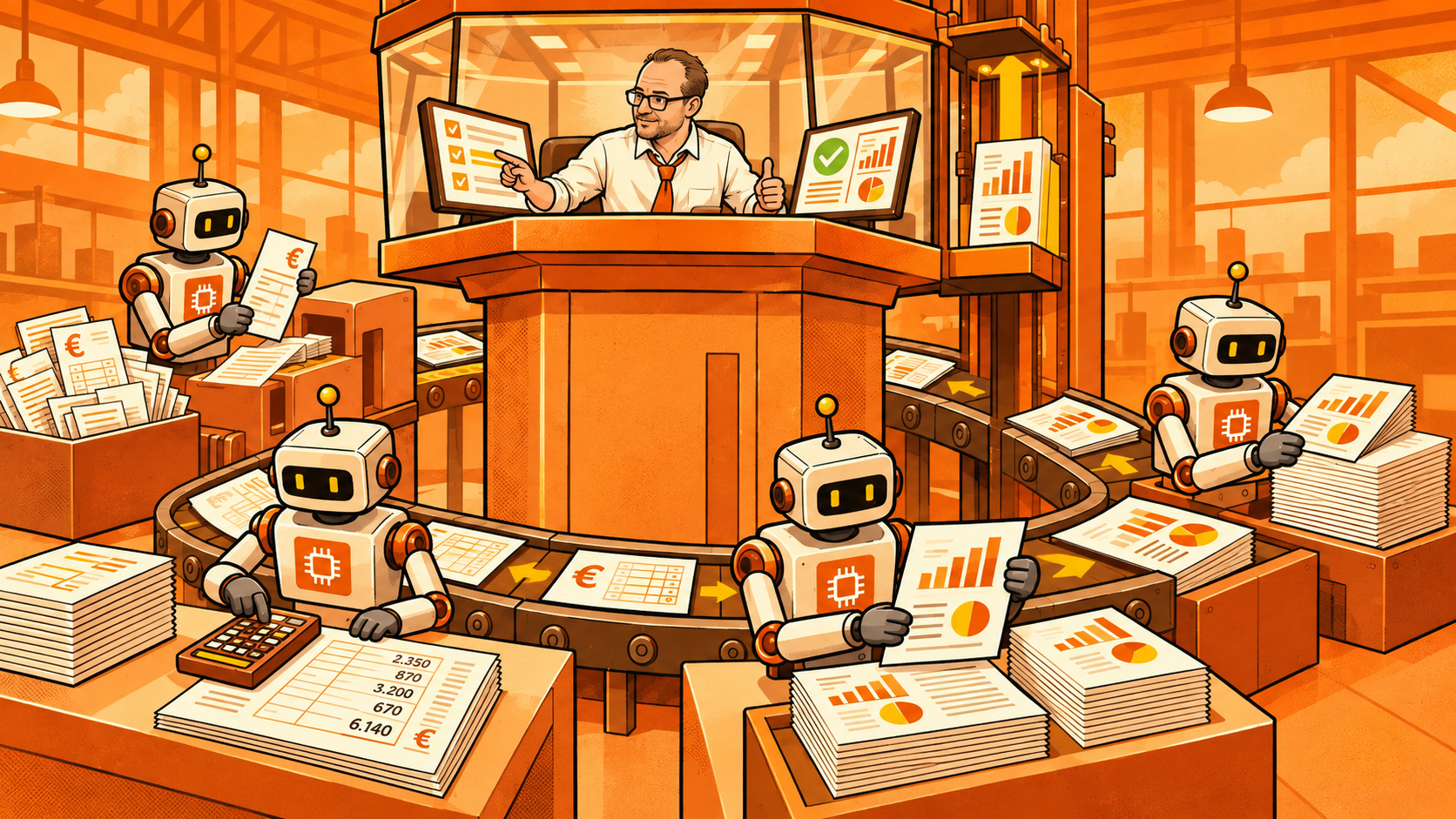
Unlike a Copilot that waits for your step-by-step instructions, you delegate a goal to Gemini. You close your computer, and it continues to work in the background to deliver a finished result upon your return, leaving you time to multiply your coffee breaks, with the incidental benefit of stimulating demand for this beverage so effective for your creativity.
Enterprise Memory vs. ChatGPT’s « Amnesia »
One of the most frustrating trait of automatic solutions like ChatGPT Enterprise is the lack of deep context without heavy configuration, which often makes AI implementation the bane of bosses and SMEs.
Gemini solves this by integrating like a true colleague (which has the advantage of never saying no, nor trying to slack off 5 minutes before the end of the day, nor attempting to badmouth you as soon as your back is turned), equipped with four levels of memory (session, semantic, procedural, and episodic – yes, I know, I don’t really know what that means either, but Google seems to know). It learns your methods and remembers the company’s history.

Even better: it can dynamically create « sub-agents » with their own email address (@agents.company.com) to coordinate complex missions. This is unprecedented multi-agent orchestration. Each of your employees then becomes a kind of super-steward, half-orchestra conductor, half-employee, to the great delight of your production and innovation capacity.
Model Openness: The Coup de Grâce to Closed Ecosystems
This is where Google hits hardest. Unlike OpenAI, which logically locks you into its own models, Google makes the strategic choice of agnosticism. The Gemini agent dynamically selects the most suitable — and most cost-effective — model for each task. It orchestrates work across its own family of models, but also integrates Anthropic’s Claude! This is a major asset for companies that refuse technological lock-in. Even though, here, we are only talking about American models…
In Conclusion: Let’s Go!
With its security guarantees and cost controls, these new Google agents are going to be a sensation and transform our work. Work will no longer begin by opening a boring app like Excel or your antiquated CRM, but in a prompt window where the employee can even speak aloud to the agent almost like a friend, or at least, like a docile, efficient, hardworking subordinate always ready to help.

A Word from Olivier Sauvage
Who is affected by these announcements?
Let’s be serious… for most companies, these innovations from Google and others remain abstract. And yet, believe me, these are not false promises. The problem is simple for management: how to integrate these new work tools into their company? Because what needs to be understood is that all this is about new generation office suites. Goodbye Excel, Word, etc. hello, AI agents. That’s really how you should see things.
Your employees will no longer have to train on these tools; they will have to learn how to use their brains to organise more effectively the tasks they will delegate to AIs, how they will be able to create more value in their organisation, and how they will also be able to make their work more enjoyable. The question here is not to look at everything from the sole angle of productivity, but from the improvement of the quality of products and services created for the company’s employees, as well as clients. In other words, how to be better.
It’s not the same thing at all. And we’re not talking about a great replacement or job elimination, because humans, once again, remain the company’s richest asset. All of this needs to start today. This transformation will be fast… undoubtedly much faster than the arrival of computing in the 1980s. And it will allow those who embrace it faster to truly gain a head start. This is not bullshit.
So, ask yourself where you really stand regarding AI and look at the path ahead. Now is the time to get started.