
Since Pinterest allowed AI content, the platform is losing its soul.
The enlightening investigation conducted by the American magazine Wired in December 2025 might be demonstrating that in the realm of social networks, too much greed can be fatal, and AI might be the poison that kills your network. The social network in question is Pinterest, a platform dedicated to DIY and crafts. The greedy ones are the Pinterest executives who thought they saw a golden goose where there was a wolf. The poison is generative AI when placed in the hands of anyone, and those ‘anyones’ are the thousands of small-time scammers who saw the opportunity to use AI on Pinterest as an open door to all sorts of scams.
A Two-Act Tragedy
As the magazine reveals, the trap closed on Pinterest in two stages.
First: Pressured to monetize its platform in 2021, Pinterest implemented an AI-based advertising program and became a giant shopping recommender for its nearly 500 million subscribers. Gradually, what made Pinterest’s essence—a place for sharing among enthusiasts and informed amateurs—faded in favor of a traditional economic model based on affiliation. More and more content became sponsored, eventually overshadowing user-driven content (especially by women) on the platform. Economically, in the short term, the move was successful, but in the long term, it’s a murder: the murder of the spirit of sharing and discovery that was the essence and soul of Pinterest.

Second: Not content with its extraordinary new performances, Pinterest introduced the aforementioned wolf into the sheepfold of images, by allowing advertisers to generate AI images directly from the platform.
I’ll let you imagine the rest.
It didn’t take long to arrive.
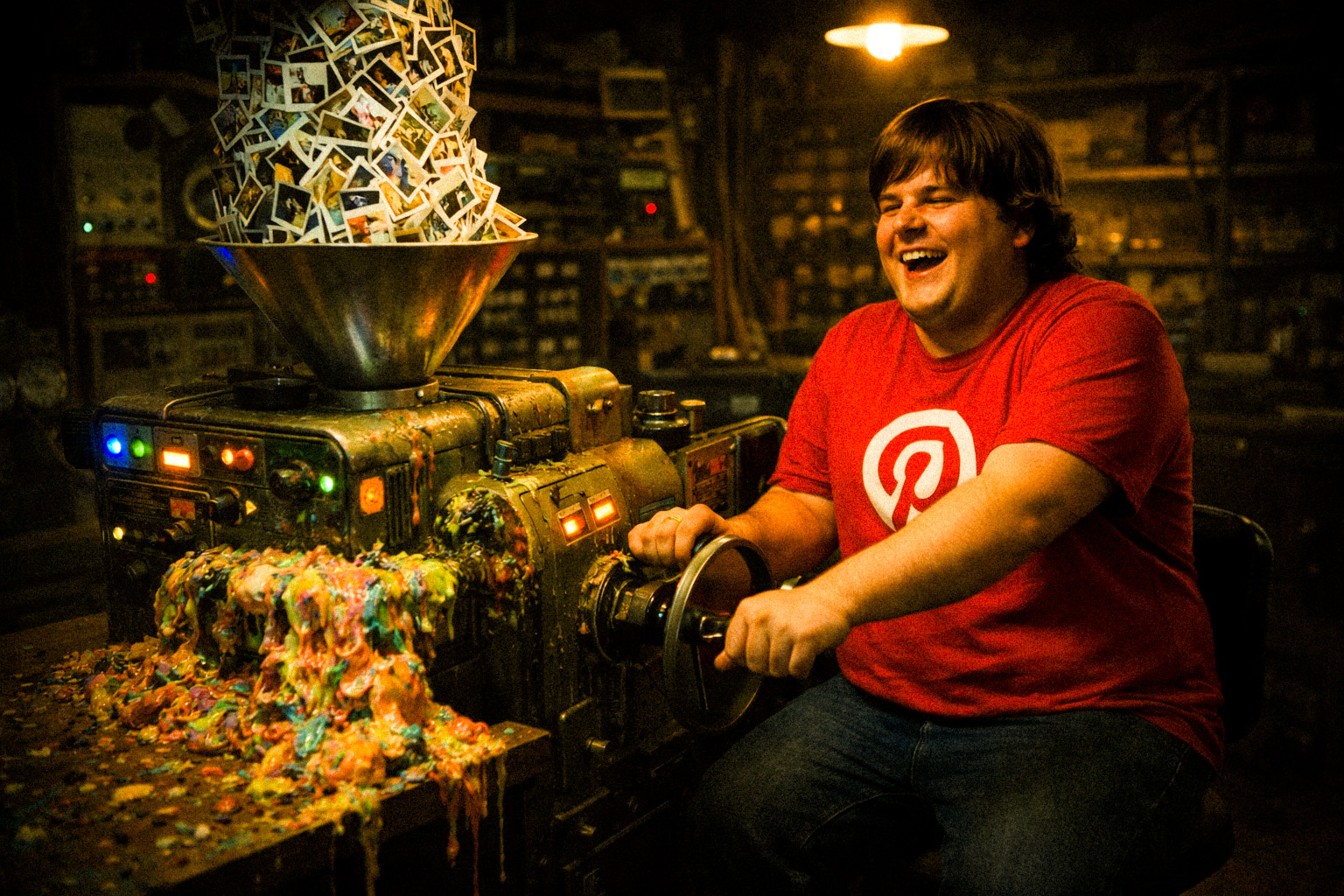
Thousands, hundreds of thousands, and probably even millions of bizarre, strange, poorly crafted, poorly assembled, curious images, as generative AIs are so adept at creating in the hands of those less concerned with quality, flooded the network. By facilitating the work of advertisers, both real and fake, they indulged themselves, transforming the rich and diverse platform of craft creations into a tsunami of ugly, delirious, fake creations, and whatever else you can imagine, completely polluting the platform and almost annihilating the spirit that animated it.
Worse still: scammers quickly rode the wave by redirecting their ads to fake e-commerce sites, with fake products, fake merchants, fake influencers, the worst of everything you can imagine. And Pinterest, despite its efforts to clean up, has already suffered the damage. Early fans are beginning to desert the platform where they once thrived and developed their network, moving to places less spoiled by AI, like Reddit (a social network gaining popularity since the arrival of ChatGPT).
Today, Pinterest is a sick network in poor health. It lost 20% of its value in the last quarter, and its profits seem to be dwindling more each day.
Is the Pinterest Phenomenon Symptomatic of a Certain Drift of Generative AIs?
It wasn’t for lack of warning. Many experts have been cautioning since the launch of ChatGPT and similar tools about the risk of a Web completely clogged by AI slop, you know, that new buzzword denouncing the alarming profusion of low-quality AI-generated content.
Today, it is the great fear of all social networks. YouTube, Insta, X, and even the very serious LinkedIn face this risk… while encouraging it. Do we not remember LinkedIn’s announcement of claiming the right to use all content generated on its platform to feed its own AI algorithms? Content itself generated by AI, according to circulating figures, now represents more than 50% of its publications.
The term AI slop aptly describes what is happening: a Web completely corroded and invaded by a true digital blight. No network is spared. Those who encourage generative AI must exert tremendous energy to preserve the integrity of their platforms. This story could not be better illustrated than with the famous broom ballet triggered by Mickey in Fantasia, the strangest of Disney films. And don’t think lessons have been learned. When we know Sam Altman’s indecent proposal to Disney to let users create videos using its gallery of famous characters for royalties, we wonder where the voracity of these AI giants will stop?

Until they destroy themselves and our mental health too?
Laisser un commentaire